BLOG POST

How to choose commercial automotive seat foam for long-term comfort and durability

November 17, 2026

The right automotive seat foam for long-term comfort is usually a high resilience (HR) polyurethane foam with enough density to resist breaking down, a firmness tuned to the seat’s job, and documented results for compression set, fatigue, and flammability. For seat cushions in commercial and fleet vehicles, that typically means HR foam of roughly 2.5 lb/ft³ or more, firmer bolsters for support, and a softer comfort layer where needed. Density predicts how long the seat will last. Firmness and support factor decide how it feels. Testing proves both before the seat reaches a driver.

This guide is for the people who specify, source, and ship seating: tier-one automotive suppliers, seating engineers, and automotive logistics directors. It covers how to read seat foam specs, how density and firmness differ, what testing to ask for, how repair and replacement programs fit in, and how returnable packaging protects seat components on the way to the line.

The short version:

  • Density decides durability. Firmness decides feel. Specify both.
  • High resilience polyurethane foam is the standard for seats that need to last.
  • Compression set and fatigue testing predict how much a seat will sag over time.
  • In the United States, automotive interior materials must meet FMVSS 302 for flammability.
  • Returnable packaging systems protect finished seat components and cut packaging waste.

Why seat foam matters more than most buyers expect

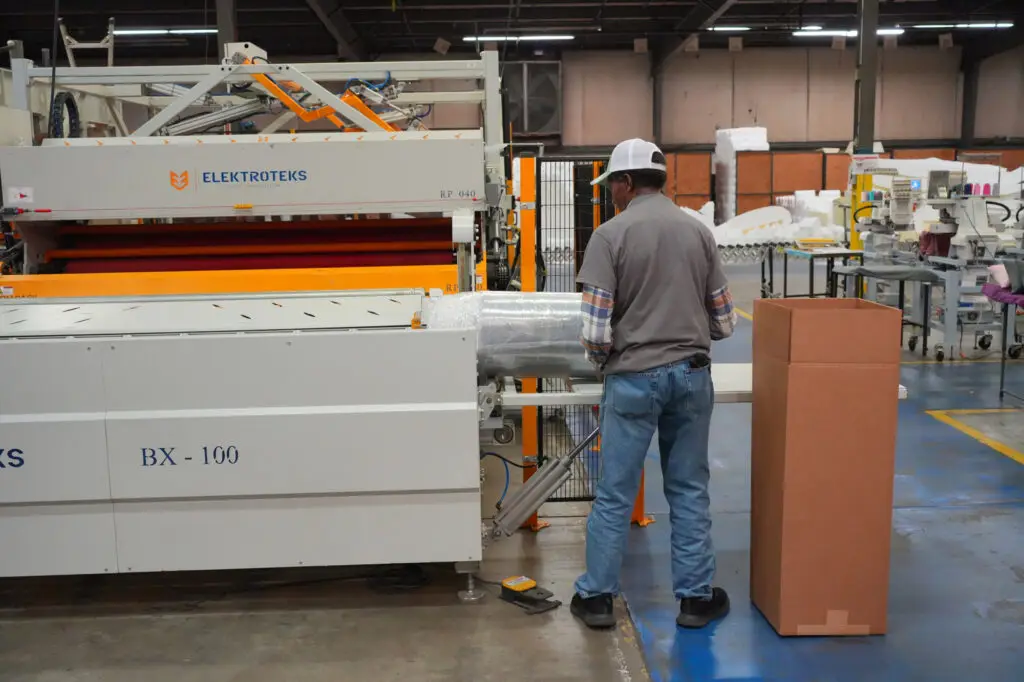
Technician overseeing automated machinery fabricating custom foam parts for automotive and marine applications.

Drivers notice seat foam long before they notice almost anything else in a vehicle. A seat that feels great on day one but sags after a year turns into complaints, warranty claims, and early replacements, especially in commercial vehicles where drivers spend eight to twelve hours a day in the same seat.

Good seat foam has to do several jobs at once:

  • Support the body so weight is spread evenly and pressure points are reduced
  • Hold its shape through years of daily use, heat, and humidity
  • Damp vibration from the road before it reaches the driver
  • Meet safety rules for flammability and, for many OEMs, low emissions and odor
  • Fit the frame and trim consistently, part after part

Automotive seat foam density. What the numbers mean

Density is the weight of foam per cubic foot (lb/ft³) or per cubic meter (kg/m³). More material per cubic foot means more structure to resist breaking down, so density is the best single predictor of how long a seat will keep its shape.

These are typical starting ranges for fabricated seat foam. Every program should confirm final specs through testing.

Typical automotive seat foam density by application
Seat application Typical foam Typical density Notes
Driver and passenger cushions, commercial vehicles High resilience polyurethane 2.5 to 3+ lb/ft³ Higher density for long daily use and heavier occupants
Seat backrests High resilience or high density polyurethane 1.8 to 2.5 lb/ft³ Less load than the cushion, so slightly lower density works
Bolsters and side supports Firmer high density polyurethane 2.0 to 3.0 lb/ft³ Firmer foam holds the body in place on turns
Comfort layers and toppers Memory foam Often 3 to 5 lb/ft³ Adds pressure relief on top of a supportive base
Low-cost conventional foam Conventional polyurethane Under 1.8 lb/ft³ Not recommended for daily commercial use, since it flattens quickly

High density automotive seat foam costs more per part, but it usually pays for itself through fewer warranty claims and longer service life.

Density is not firmness

This trips up many buyers. A dense foam can feel soft, and a lighter foam can feel firm. Firmness is measured separately, as IFD or ILD (indentation force deflection): the force needed to compress the foam by a set percentage.

Two more measures complete the picture:

  • Support factor, sometimes called sag factor, compares the force at 65 percent and 25 percent compression. A higher support factor means the foam feels soft on the surface but pushes back firmly as you sink in, which is what makes HR foam comfortable for long drives.
  • Resilience measures how quickly the foam springs back. HR foam has high resilience, which helps the seat recover between uses.

For seats, many programs use dual firmness: firmer foam in the bolsters and front edge for support, softer foam in the center for comfort.

The specs that predict long-term durability

Comfort on day one is easy. Comfort in year five depends on how the foam ages. These are the properties worth specifying and testing, most of them using ASTM D3574, the standard test methods for flexible polyurethane foam.

Automotive seat foam properties and why they matter
Property What it measures Why it matters for seats
Density Mass per unit volume Best single predictor of durability
IFD or ILD Force to compress the foam a set amount Controls how firm the seat feels
Support factor Ratio of firmness at deep and light compression Predicts long-drive comfort and support
Compression set Permanent height loss after being held compressed Shows how much the seat will sag over time
Dynamic fatigue Height and firmness loss after repeated loading Simulates years of getting in and out
Resilience How fast the foam springs back Affects comfort and recovery between uses
Flammability Burn rate under FMVSS 302 Required for vehicle interior materials in the United States
Emissions and odor VOCs, fogging, and smell Many OEMs set limits for cabin air quality

Ask suppliers for test data on the exact foam grade you will receive, not a general brochure. Humid aging results are especially useful for vehicles that operate in hot, wet climates.

Molded vs fabricated seat foam

Most high-volume passenger car seats use molded foam, poured into a seat-shaped tool. Many other seating programs use fabricated foam instead, cut and shaped from high resilience foam blocks.

Fabricated seat foam is often the better fit for:

  • Commercial and fleet vehicles, including trucks, buses, and delivery vans
  • Specialty vehicles, such as RVs, agricultural equipment, and marine seating
  • Lower to mid-volume programs where mold tooling is hard to justify
  • Prototypes and design changes, since a new shape does not require a new mold
  • Replacement and repair programs

Fabricators cut foam with CNC routing, contour cutting, and water-jet equipment, then laminate layers of different density and firmness to build dual-firmness cushions.

Automotive seat repair and replacement programs

For fleets, dealerships, and upholstery shops, automotive seat repair usually means replacing worn cushion foam rather than the whole seat. The same rules apply as for new seats:

  • Match or improve on the original density. Replacing worn foam with a cheaper, lower density foam starts the sagging cycle again.
  • Match the firmness and shape, including bolsters, so the cover fits and the seat feels right.
  • Use HR foam for driver seats that see daily use.
  • Add a comfort layer if drivers want more pressure relief, but keep the support layer firm.
  • Check flammability compliance for any foam going into a vehicle interior.

For fleets that repair seats regularly, pre-cut replacement cushions made to a consistent spec save time and keep every vehicle feeling the same.

Protecting seat components with returnable packaging systems

For logistics directors, the seat’s journey to the assembly line matters too. Foam cushions, trimmed seat covers, and finished seat assemblies are easy to crush, scuff, or soil in transit.

Returnable packaging systems, such as reusable racks, totes, and bins with fitted foam dunnage, solve this by:

  • Holding each part in a fixed position so trim and covers are not crushed or marked
  • Standardizing quantities per container, which simplifies counting and line-side delivery
  • Cutting single-use packaging waste and the labor of breaking down cardboard
  • Lasting for many trips between supplier and plant

Our guide to protecting fragile freight covers how custom foam dunnage is designed around real shipping conditions.

A checklist for choosing an automotive seat foam supplier

  •  Do you fabricate seat foam in-house? In-house cutting controls consistency and lead times.
  •  Which foam grades can you supply? Look for HR, high density, and memory foam options.
  •  Can you provide density, IFD, and support factor data for each grade?
  •  What durability testing do you have? Ask for compression set, fatigue, and humid aging results.
  •  Does the foam meet FMVSS 302? Ask for current documentation.
  •  Can you meet our emissions and odor requirements? Many OEMs have their own specs.
  •  Can you laminate dual-firmness cushions? Bolsters and comfort layers often need different foams.
  •  How do you hold tolerances across long runs? Seat foam must fit frames and trim every time.
  •  Can you supply returnable packaging and dunnage? One partner for parts and packaging reduces handoffs.

How HLJ Foam supports automotive seating programs

HLJ Foam has been manufacturing foam in the United States since 1988, with experience in automotive and marine interiors. We produce and fabricate polyurethane, high density, and memory foams, and our custom foam fabrication team cuts seat foam with CNC routing, contour cutting, and water-jet equipment for consistent shapes run after run.

For tier-one suppliers and fleets, we support prototypes, production runs, and replacement programs through OEM and contract manufacturing. For logistics teams, we design custom foam packaging and supply plastic totes and bins with fitted foam inserts for returnable programs. Our materials guide covers the full range of foams we work with.

Want to learn more about density first? Our guide to high density foam explains how density and firmness work together.

Planning a seating program or a seat repair line? Talk to our team about specs, samples, and timelines.

FAQ

What foam is used in car seats? Most car seats use flexible polyurethane foam, usually high resilience (HR) foam for cushions and backrests. Some seats add memory foam comfort layers or firmer foam in the bolsters for extra support.

What density foam is best for automotive seats? For seat cushions that see daily use, high resilience polyurethane foam of about 2.5 lb/ft³ or more is a common starting point. Backrests can use slightly lower density, and final specs should be confirmed through testing.

What is high resilience foam? High resilience foam is a polyurethane foam with a more irregular cell structure that springs back quickly and offers a high support factor. It feels soft on the surface but supports firmly as you sink in, which makes it well suited to seating.

What is the difference between foam density and firmness? Density is the weight of foam per cubic foot and predicts durability. Firmness, measured as IFD or ILD, is how hard the foam feels. A dense foam can be soft, and a less dense foam can be firm.

How long does automotive seat foam last? Well-specified high density seat foam can keep its shape for many years of daily use. Lower density foam can start to sag within a year or two, especially in commercial vehicles with long daily driving hours.

What standard applies to automotive seat foam flammability? In the United States, vehicle interior materials, including seat foam, must meet FMVSS 302, which limits how fast materials can burn.

Can I repair a car seat by replacing the foam? Yes. Many seat repairs replace the worn cushion foam while keeping the frame and cover. Use foam that matches or exceeds the original density and firmness so the seat feels right and lasts.

Leave a Reply

Your email address will not be published. Required fields are marked *